
Why Being Chosen Isn’t the Same as Being Loved
Being chosen can feel like love. Especially when you spent years watching someone else get chosen instead.
There’s a specific kind of hunger that comes from growing up watching someone else get chosen.
A close female relative of mine — someone I grew up alongside — seemed to receive everything effortlessly. The attention. The tenderness. The way the adults in the room turned toward her like she was the sun. And I watched, quietly, trying to understand what she had that I didn’t. What I needed to fix, improve, become. What would finally make me the one they turned toward.
I didn’t understand it then. But I understand it now.
That early experience taught me something that took years to unlearn: that love is something you earn. That being chosen is the goal. That if you’re not the one being selected, the problem is you — and the solution is to make yourself more palatable, more useful, more undeniable.
It also taught me to recognize a certain kind of woman. The ones who know how to perform for attention. Who understand instinctively how to position themselves to be chosen. Who move through rooms collecting selection the way others collect achievements. I’ve met versions of her throughout my life — in friendships, in workplaces, in the quiet competitions that women are never supposed to acknowledge are happening.
And I spent a long time believing that if I could just be chosen — really, finally, unambiguously chosen — it would feel like love.
It doesn’t. And that distinction is the thing I wish someone had told me sooner.
Being chosen is a decision.
Being loved is a practice.
Being chosen is a moment. Someone looks at their options and selects you. Maybe it’s because of timing. Maybe it’s convenience. Maybe it’s because you showed up at exactly the right point in their story and fit a need they had. Maybe it’s because you worked hard enough, changed enough, made yourself useful enough to finally tip the scale.
Being loved is different. It’s not a decision made once — it’s something someone does, over and over, in the small moments that don’t require an audience. It’s in whether they remember what matters to you. Whether they show up when it costs them something. Whether they check in without needing anything in return.
"Being chosen is a decision. Being loved is an ongoing practice. And the difference shows up not in the grand moments — but in the ordinary ones."
The problem is that being chosen can mimic love convincingly enough to fool you — especially if you’ve been hungry for it for a long time. Especially if you grew up watching someone else get it and wondered, quietly, what was wrong with you.
What being wanted around actually looks like — versus being valued
Here’s the difference as I’ve lived it. Not in theory. In behavior.
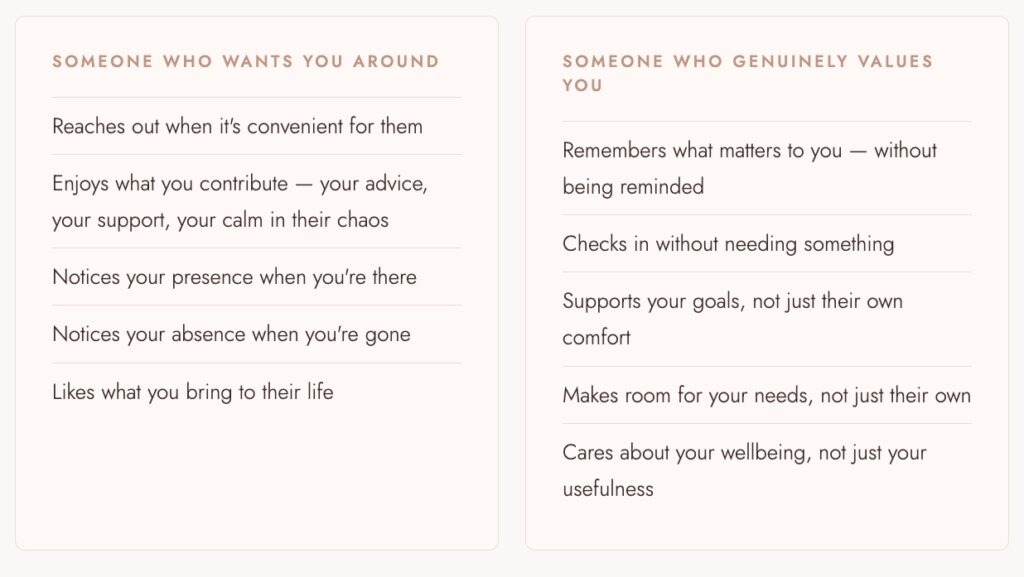
One of these feels like love. The other one is love.
The tricky part is that someone can want you around very much and still fail to love you well. The wanting is real. The love is just — not quite there. Which is perhaps the most disorienting combination a person can experience.
Someone who wants you around enjoys what you bring. Someone who values you cares about who you are.
That sentence took me a long time to understand. Even longer to apply.
The slow realization that being chosen isn’t the same thing
It didn’t hit me all at once. It never does, with the things that matter most.
It dawned slowly, across multiple experiences, like a picture developing in a darkroom. I kept being chosen — and yet kept feeling unseen. I kept making the cut — and yet kept feeling like I was one wrong move away from being replaced. I kept earning my place — and still felt like I was holding it on borrowed time.
And eventually I understood: being chosen can be about convenience. About timing. About someone’s need at a particular moment in their life. You can be chosen and still not be truly seen. You can be someone’s first choice and still feel invisible. You can be selected, wanted, picked — and still be completely alone in the relationship.
“You can be someone’s first choice and still feel invisible. Being chosen and being loved are not the same country — they just share a border.”
Ellie
author of still gentle, still me
The pattern I noticed — in that early relationship with my relative, and in the women who reminded me of her later — was this: some people are very skilled at being chosen. They understand the performance of desirability. They know how to position themselves to be selected. But being chosen, even repeatedly, by many people, is not the same as being genuinely known and loved by anyone.
I used to envy that skill. I don’t anymore.
What it actually feels like to be truly seen
I’ve been lucky enough to experience it — not in every relationship, not as often as I’d like, but in enough moments to know what it feels like. And it feels nothing like I expected.
It doesn’t feel electric. It doesn’t feel like finally winning. It doesn’t feel like relief, exactly, though there’s something adjacent to relief in it.
It feels safe. It feels peaceful rather than exciting. It feels like someone noticing things I never said out loud — the tiredness I perform away, the softness I protect with competence, the fears I never quite give words to.
It feels like someone understanding that I can be strong and still need support. That being capable doesn’t mean being self-sufficient. That managing everything gracefully doesn’t mean I’m fine.
“Being seen feels like someone noticing the woman building the business — not just the business she’s building.”
Ellie
author of still gentle, still me
That’s the difference. Being wanted focuses on what you do. Being loved focuses on who you are. And for those of us who learned early to make ourselves useful in order to be kept — that distinction is everything.
Why women like us confuse the two — and why it makes complete sense
If you grew up watching someone else receive love more freely than you — if affection felt like something distributed unevenly, something you had to work harder for — of course you’d equate being chosen with being loved. Of course selection would feel like the goal. Of course you’d develop a radar for what makes someone choose you, and calibrate yourself accordingly.
It’s not a flaw. It’s an adaptation.
Adaptations are very useful until the environment changes and they're not. At which point they mostly just cause problems in your relationships and give you interesting things to write about.
The women I’ve known who were skilled at being chosen — the ones who reminded me of my relative, who collected selection like currency — I don’t think they were malicious. I think they were also, in their own way, hungry. Just running a different strategy for the same scarcity.
And those of us who kept being overlooked, kept working harder, kept waiting to finally be enough — we were running our own strategy too. The “earn it” strategy. The “make yourself impossible to replace” strategy. The one that keeps you exhausted and still somehow insecure.
Neither strategy is love. Both come from the same wound.
What I wish someone had told me earlier
Being loved shouldn’t feel like constantly proving your worth.
That’s the whole sentence. That’s the one I needed at twenty-something, watching someone else get chosen and trying to understand why. That’s the one I needed every time I caught myself working harder to maintain a place that should have simply been mine.
Real love makes room for who you are — not just what you provide. It doesn’t require you to be perpetually useful, perpetually impressive, perpetually low-maintenance enough not to be replaced.
Being chosen is a decision someone makes. It can be revoked. It can be conditional. It can depend entirely on whether you keep performing.
Being loved is different. It’s something someone practices, consistently, in the unremarkable moments. It’s in the checking in. The remembering. The making space for your needs alongside their own.
“Stop settling for being chosen. It was never the thing you were actually hungry for.”
Ellie
Author of still gentle, still me
What you were hungry for — what most of us are hungry for, underneath the performance and the earning and the careful positioning — is to be known. Fully. Without having to earn it. Without the quiet terror of being replaced if you stop being useful enough.
That’s not too much to want. It was never too much to want.
If this resonated — share it with the woman who needs to read it. She probably won’t send it to herself. That’s kind of the whole pattern.
And if you want more of this — the honest version, with less toxic positivity and more actual truth — come find me in the Quiet Corner. It’s free and it’s for you. 🤍
— Ellie